
Our current Artist-in-Residence, Rob Lye, has been very busy recently. His solo exhibition, Fog Machine, concluded in May, and he has also just returned from a short residency in the Arctic with the Arctic Circle programme.
We recently caught up with Rob to hear about his experiences and reflections on his time in the Arctic.
How was the journey from the UK to the Arctic? Could you describe your travel experiences?
The journey from London to Svalbard was very easy, a short flight from London to Oslo, and then from Oslo to Svalbard. I was very excited and nervous, and somehow managed to pack far too much stuff!
What was life like on the boat? What did you do during the day and in the evenings?
The Arctic Circle residency is a two-week programme sailing around Spitsbergen aboard a 100-year-old schooner with 30 other artists. It was an incredible experience. Every day we made a different landing and visited sites including glaciers, mountains, and landscapes that felt completely otherworldly.
In the evenings, we socialised and drank a lot of red wine! Being around so many people was unusual for me, as I tend to enjoy my own company, but I met some wonderful people whom I hope to stay in contact with.
Day and night were not really defined, as there is no darkness, just continuous daylight.
What struck you most about being in the Arctic?
Seeing glaciers, and walking on glaciers that are thousands of years old, was overwhelming at times. The landscape was incredibly beautiful, but there was a violence to it as well. Watching glaciers calve was a particular highlight. You could sense so much latent energy in the landscape that, when it seemed to flex, you realised just how powerful nature is.
That must have been quite a thing to witness in person. The violence you mentioned seems to be part of the landscape. In terms of safety, were you allowed to explore on land? If so, what was that experience like?
Yes, we explored many different landscapes, and the experiences were all very different. My favourite places were the edges of glaciers. Glaciers are incredibly majestic, but their edges are particularly interesting, the way rocks are dispersed across the ice, the visible effects of permafrost, and the strange geology we encountered were fascinating.
What really struck me was that when things die, they cannot properly decompose because everything is frozen. We saw graves that were a few hundred years old, marked only by piles of rocks, because the permafrost continually brings things back from the past.
This relationship with time was especially interesting to me and has become a starting point for the work I am making. Ideas of slow time, and the relationship between our experience of time as humans and the landscapes we inhabit, felt like a natural continuation of the themes explored in the exhibition I presented at the Gerald Moore Gallery.
Did the air feel different from the air in London? If so, how?
The air felt terrible when I got back to London! Glaciers have a particular scent, a freshness that was wonderful. When we were near the edges of glaciers, we could hear and feel bubbles of air escaping from ice that was literally thousands of years old.
It felt pretty good!
Moving from the sound of escaping bubbles of air trapped in the ice, what kinds of recordings did you make? How would you describe the quality and character of the sounds you captured?
I shot a lot of video footage of the landscape and recorded a great deal of sound using a special ambisonic microphone and a hydrophone (an underwater microphone).
The most memorable recording experience was capturing the sound of a glacier calving. It happened completely by chance while we were sitting in a Zodiac (a small inflatable speedboat) in front of a glacier, next to a huge iceberg (picture 1). As the glacier calved, a powerful series of waves rippled across the water towards us, causing the iceberg beside us to bob and shift dramatically.
The experience was incredible. For a moment, I genuinely thought we might be in trouble. If the iceberg had broken apart, we could potentially have been dragged underneath it, it was the size of a house. Our guide kept his hand on the engine the entire time, ready to move if necessary.
Everyone in the Zodiac remained completely still and quiet because we all understood just how special the moment was. The sound itself was extraordinary. The initial crack of the glacier sounded like gunfire, followed by the immense rush of ice-filled waves moving towards us. It was both terrifying and awe-inspiring. When we returned to the main ship, we continued to watch the glacier calving in the distance. The iceberg we had been sitting beside was eventually dragged underwater and shattered into thousands of pieces.
I think our guide may have received a slight telling-off afterwards, but I later took him aside and told him that everyone in our Zodiac agreed it had been one of the most beautiful and life-affirming moments we had ever experienced.
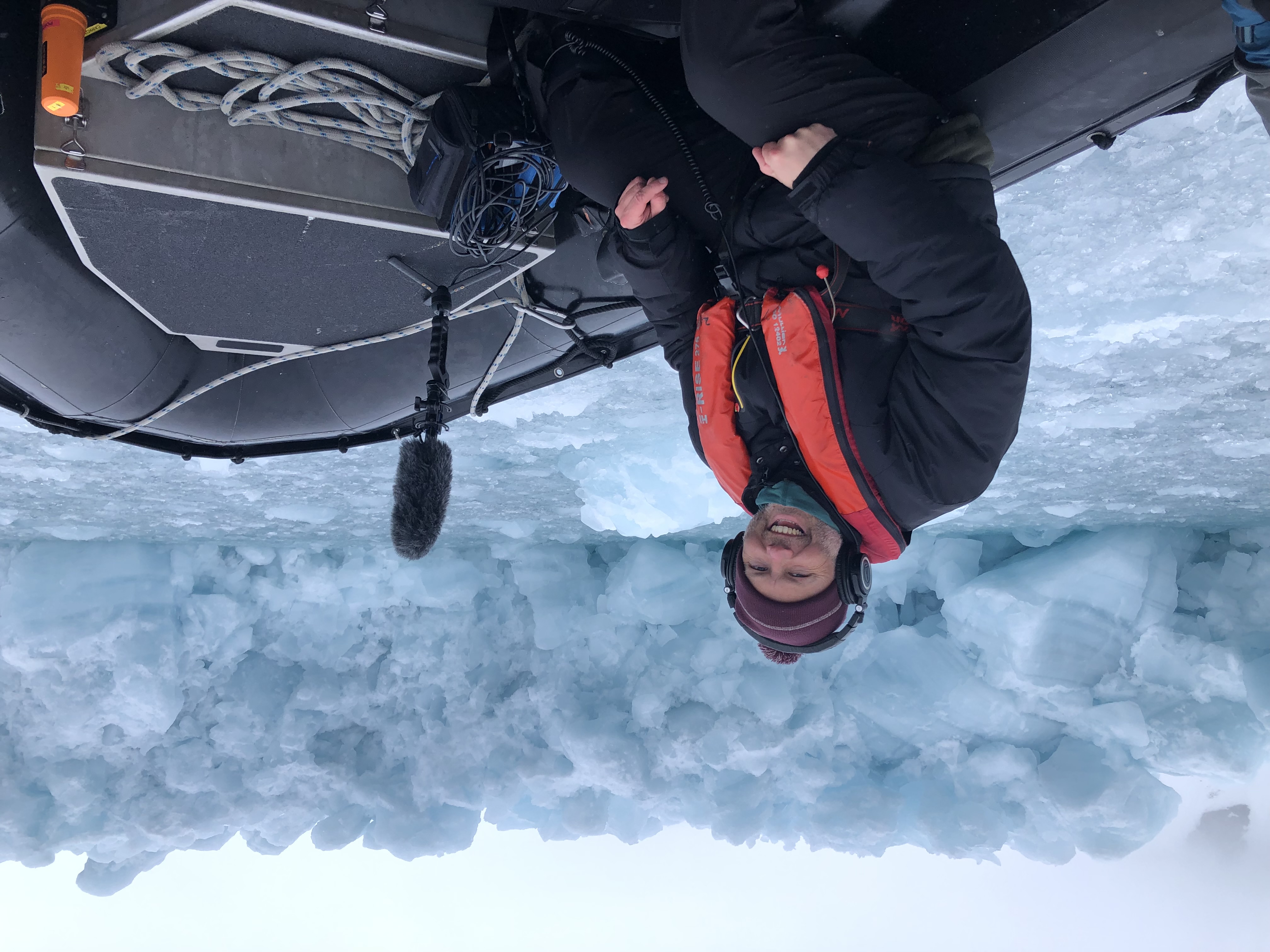
Picture 1: Rob next to an icebery before it calved. Photo courtesy of the artist.
Did you see any wildlife? Were you lucky (or unlucky) enough to see any polar bears?
I did see a polar bear! I also saw walruses and lots of beautiful birds. One of the many creative highlights of the trip was recording the sounds of grey seals through an iceberg using an underwater microphone.
I somehow managed not to fall into the sea as well, which was a miracle!
Did you feel safe both on and off the ship? Why or why not?
I always felt very safe, and our guides were incredible. They were deeply knowledgeable and worked incredibly hard to help 30 artists realise their projects, some of which were totally bonkers!
They carried rifles, and we were carefully monitored whenever we were ashore, as the threat posed by polar bears is very real.
What were the other crew members like? Were they all artists, or did they come from different backgrounds?
Both the crew and artists were international, which was wonderful. I made friends with people from all over the world, including some incredibly talented artists.
I feel we shared an entirely unique experience that now seems like some kind of strange fever dream, very far removed from my life in England.
Fortunately, I have around ten hours of high-definition video to remind me of those wonderful times, as well as many field recordings to edit back in my studio at Eltham College.
Unfortunately, the chefs working below my studio also have to listen to them.
Sorry, guys, the studio isn't soundproofed!